Immortalized in Paint & Stone: Pet Portraits Through History
April 10, 2026
Posted by marko
From pharaoh's hounds to Instagram-famous cats — humanity's obsession with memorializing its beloved animals is older than you think.
Long before the smartphone made every pet a potential celebrity, humans were commissioning artists to immortalize their four-legged companions. The impulse is surprisingly ancient: to look upon an animal you love and think, this creature deserves to last forever. What follows is a journey through the art of the pet portrait — from temple walls in ancient Egypt to the gilded salons of Versailles, from Victorian parlors to the pixel-perfect present.
circa 3500 BCE – 30 BCE
Ancient Egypt: Sacred Animals & Sacred Bonds
The Egyptians were, arguably, the world's first great pet portraitists. Cats held a divine status, associated with the goddess Bastet, and were depicted everywhere — in tomb paintings, amulets, and bronze sculptures meant to accompany their owners into the afterlife. Dogs, too, were cherished: inscriptions from as far back as 3500 BCE record pets by name, and tomb reliefs show hounds lounging beneath their masters' chairs.
These weren't merely symbolic representations. Many show specific animals with distinctive markings and collars, suggesting a genuine desire to record individual animals rather than generic archetypes. The detail lavished on a greyhound's lean flank in a New Kingdom tomb painting was an act of love as much as ritual.
Left: Egyptian cat deity sculpture style. Right: Roman mosaic dog, as found in Pompeii.
1st Century BCE – 5th Century CE
Greece & Rome: Dogs, Mosaics & Epitaphs
The ancient Greeks wrote poetry for their dogs. The Roman poet Martial composed a touching epitaph for a small dog named Issa, describing her as more loving than any dove, more precious than Indian gems. Romans commissioned floor mosaics depicting their dogs — most famously the "Cave Canem" (Beware of Dog) mosaic found in Pompeii, showing a chained black dog in naturalistic detail.
What strikes the modern eye is how personal these images feel. The Roman dog mosaic isn't generic; it depicts a specific animal, with coloring, posture, and personality rendered with evident affection. The desire to individualize one's pet — to say this dog, not just a dog — appears to be a deeply human constant.
— Martial, Roman poet, 1st century CE
1400s – 1700s
The Renaissance & Baroque: Pets as Status Symbols
During the Renaissance, pets began appearing as deliberate props in portraiture — a way of signaling wealth, refinement, and even moral virtue. Lapdogs in particular became fashionable accessories for noblewomen, appearing at their mistresses' feet in major works by Titian, Velázquez, and Van Eyck. The dog in Titian's portrait of the young Clarissa Strozzi (1542) is not background detail — it is a co-protagonist, its gaze as alive as the child's.
By the Baroque period, some wealthy patrons were commissioning portraits of their animals alone — a remarkable development. Philip IV of Spain employed Velázquez to paint his hunting dogs as individual subjects. In the Dutch Golden Age, painters like Paulus Potter achieved fame for animal paintings of extraordinary technical virtuosity. Pets had graduated from accessories to subjects.
1700s – 1800s
Georgian & Victorian England: The Golden Age of the Pet Portrait
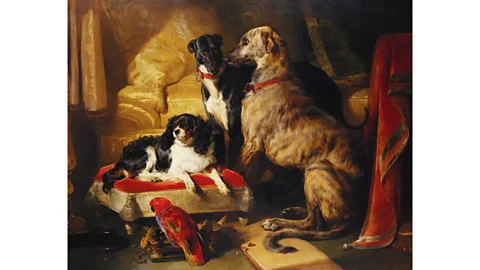
If there is a golden age of the pet portrait, it is surely eighteenth and nineteenth century Britain. The English obsession with animals — hunting dogs, racehorses, beloved companions — generated an entire industry of animal portraiture. George Stubbs elevated the horse painting to high art; Edwin Landseer became Queen Victoria's preferred painter of her many dogs and became so famous that the Landseer Newfoundland breed is named for him.
Victoria herself was an enthusiastic patron, commissioning portraits of dozens of her pets. Her grief at the death of her greyhound Eos was genuine and publicly expressed — and artistically commemorated. This era also saw the rise of the memorial portrait: pets painted posthumously, from memory or earlier sketches, to preserve the likeness of a lost companion. The sentimentality was earnest and unapologetic.
The Georgian and Victorian era produced some of the most technically refined animal portraits in Western art history.
1839 – 1990s
Photography Changes Everything
The invention of photography in 1839 democratized the pet portrait in ways that would have astonished a Victorian art patron. For the first time, a middle-class family could have an image of their cat or dog that was detailed, accurate, and relatively affordable. Early photographers quickly discovered that animals made compelling (if unpredictable) subjects, and the pet photo became a staple of domestic life.
Yet oil painting didn't disappear. Throughout the twentieth century, the commissioned pet portrait remained a luxury item — a way of elevating one's animal above the snapshot and into art history. Naive and folk painters offered more affordable versions; highly trained academic painters continued to serve the wealthy. The hierarchy of mediums mapped neatly onto the hierarchy of class.
2000s – Present
The Digital Age: Every Pet a Celebrity
The internet did not invent the love of pets — but it did give it an unprecedented platform. Instagram accounts for cats and dogs amass millions of followers. A cottage industry of digital artists, watercolorists, and oil painters now offers custom pet portraits at every price point, from a five-dollar digital sketch to a thousand-dollar framed oil painting. Etsy alone lists tens of thousands of sellers specializing in nothing else.
More recently, AI image generation has entered the conversation — raising familiar questions about originality, authorship, and the value of human skill. But the impulse behind it all remains unchanged: someone loves an animal, and wants that love made visible, made permanent, made art.
What the history of pet portraiture reveals, more than anything else, is the depth and consistency of the human-animal bond. Across five thousand years, through empires and revolutions, through oil paint and mosaic tile and digital pixels, we have always found ways to say: this animal was loved, and deserves to be remembered. The medium changes. The love doesn't.
0 people likes this post