The Fluffy Muse: A History of Pomeranian Portraits
April 14, 2026
Posted by marko
From Gainsborough's canvas to Victorian drawing rooms — how one spirited little breed became one of the most painted dogs in Western art.
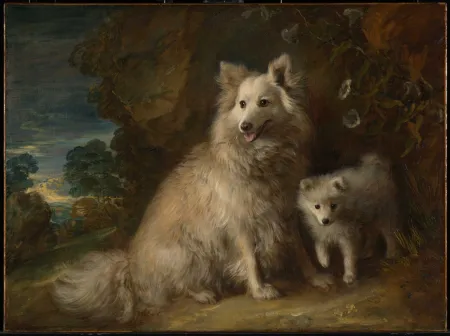
"The deception was so complete that the elder subject, irritated at the presence of a supposed rival, flew at her own resemblance with such fury."
— Anecdote about Gainsborough's Pomeranian Bitch and Puppy, c.1777
A breed with royal roots
Long before the Pomeranian became a fixture of Instagram feeds and city apartments, it was a dog of palaces and parlours — a creature so beloved by European royalty that painters of the highest calibre were called upon to preserve its likeness in oil on canvas. The story of Pomeranian portraiture is, in many ways, the story of how dogs earned their place as subjects worthy of serious artistic attention.
The breed itself traces its origins to the Baltic coastal region of Pomerania — today spanning northern Poland and eastern Germany — and descends from the larger Spitz-type working dogs of northern Europe. Known variously as the "wolf dog," "fox dog," and "loup loup," Pomeranians were far larger in earlier centuries than the compact companions we recognise today.
Breed at a glance
Gainsborough and the first great Pomeranian portraits
It was the great English portrait and landscape painter Thomas Gainsborough (1727–1788) who first elevated the Pomeranian to genuine artistic subject. Though famous for his human sitters and luminous landscapes, Gainsborough was deeply fond of dogs and painted them with exceptional psychological sensitivity.
His earliest known Pomeranian work, The Spitz Dog (c.1765, Yale University Art Gallery), depicts an alert, energetic creature radiating personality. His most celebrated Pom painting, Pomeranian Bitch and Puppy (c.1777, Tate), belongs to a different register entirely — intimate and tender, showing a mother watching over her inquisitive puppy against a landscape brushed with dramatic, fast strokes.
"Gainsborough fills this portrait with emotions and sets the dogs in a landscape expertly painted with fast and dramatic brushstrokes."
— DailyArt Magazine, on Pomeranian Bitch and PuppyThe dogs in the Tate painting belonged to Carl Friedrich Abel, the last great virtuoso of the viola da gamba and one of Gainsborough's closest friends. The painter likely exchanged the portrait for music lessons — a creative barter between two artists who adored each other's company. When the finished canvas arrived at Abel's house, according to one biographer, the real dog recognised herself so vividly she reportedly attacked the canvas in jealous fury.
Queen Charlotte and the arrival of the Pom in royal circles
Pomeranians arrived in England in grand style. Queen Charlotte, consort to King George III, brought the breed with her when she came to court — her two dogs, Phoebe and Mercury, were among the first Pomeranians widely seen in England. Gainsborough himself painted portraits of the Queen that may have featured these very animals.
At this stage, however, the breed was still medium-sized by modern standards — closer to a small herding dog than the lap-sized powder-puff we know today. It would take another generation of royal enthusiasm to change that.
The Victorian revolution: Queen Victoria shrinks the Pom
The most dramatic transformation in both the breed's size and its artistic legacy came with Queen Victoria. The monarch became a devoted Pomeranian breeder, and because one of her favourite Poms — named Marco — was notably small, the miniaturised variety became universally fashionable. During Victoria's lifetime, the standard size of the breed is said to have decreased by roughly half.
Victoria's dogs were treated as members of the household. Special carriages were arranged for them on the royal train. Senior officials who failed to show proper respect to the royal Pomeranians risked the Queen's displeasure. Special policemen ensured the dogs' safety at public events. When Victoria lay on her deathbed, her final request was said to be for her favourite Pomeranian to be brought to her side.
"Queen Victoria was very severe with officials if they did not pay proper attention to her favourite dogs, and special policemen ensured the safety and security of her dogs at all times."
— Geri Walton, Pomeranians and Their Popularity in the 19th CenturyThe Victorian era also saw dog portraiture mature as a serious artistic genre. Dog shows grew popular. Breed standards were formalised. Portraits of prize-winning dogs became both personal keepsakes and records of breeding excellence — a tradition that sits somewhere between the modern kennel photograph and the Renaissance court portrait.
The artists who painted Pomeranians
Thomas Gainsborough
1727–1788 · British
The first great painter of Pomeranians. His Pomeranian Bitch and Puppy (c.1777) at Tate remains one of the finest dog portraits ever made — rich in emotion and landscape atmosphere.
Edwin Landseer
1802–1873 · British
Queen Victoria's favourite animal painter. Landseer painted over a dozen portraits of royal pets under Victoria's patronage, helping to set the tone for Victorian canine portraiture.
George Stubbs
1724–1806 · British
Generally credited with elevating dog painting to academic status. He exhibited more dog paintings than horse paintings at the Royal Academy during his lifetime, despite his equine fame.
A timeline of Pomeranian portraiture
c.1765
Gainsborough's The Spitz Dog
One of the earliest standalone Pomeranian portraits in Western art. Now at Yale University Art Gallery, it depicts a sharply alert, purposeful dog — practically stepping off the canvas.
c.1777
Gainsborough paints Pomeranian Bitch and Puppy
Created for musician Carl Friedrich Abel, likely in exchange for viola da gamba lessons. Now at Tate, London — regarded as a masterpiece of animal portraiture.
1785
Pomeranian in a society portrait
Gainsborough's Portrait of Mr. and Mrs. William Hallett features a large Pomeranian — a status symbol in fashionable 18th-century society.
Late 1700s
Queen Charlotte brings Poms to court
The Queen-consort to George III arrives in England with two Pomeranians — Phoebe and Mercury — who are later painted by Gainsborough.
1830s–1890s
The Victorian golden age of dog portraiture
Queen Victoria breeds Pomeranians on a grand scale. The miniaturised Pom becomes fashionable across Britain. Artists including Landseer and Charles Burton Barber capture the era's canine devotion.
19th century
Antique oil portraits proliferate
English and French artists produce numerous small-format Pomeranian oil portraits for private collectors — now sought by antique collectors and dog lovers worldwide.
Today
The tradition continues
From contemporary oil painters to digital commissions, Pomeranian portraiture remains vigorously alive — the instinct to preserve this particular fluffy face in art is apparently irresistible.
Why the Pomeranian captivated artists
There is something painterly about the Pomeranian itself. The thick double coat creates extraordinary textural possibilities — Gainsborough's quick, energetic brushstrokes were perfectly suited to rendering that cloud of fur. The fox-like face, with its sharp nose and bright, watchful eyes, gives every portrait an immediacy that flat-faced breeds rarely achieve. And the tail, curled over the back like a plume, is a natural compositional flourish.
The breed's expressiveness also helped. Pomeranians are alert, curious, and opinionated — qualities that translate into portraits with genuine character. Gainsborough reportedly took as much care capturing the "personalities of his canine sitters" as his human ones. The Pomeranian, with its strong sense of self, rewarded that attention.
The Pomeranian portrait tradition also reflects something deeper: a centuries-long human desire to honour the creatures we love by rendering them in art. From Gainsborough's music-room paintings to Queen Victoria's sketchbooks, the impulse is the same — to say, this dog mattered, this dog was here, this dog was ours.
0 people likes this post